
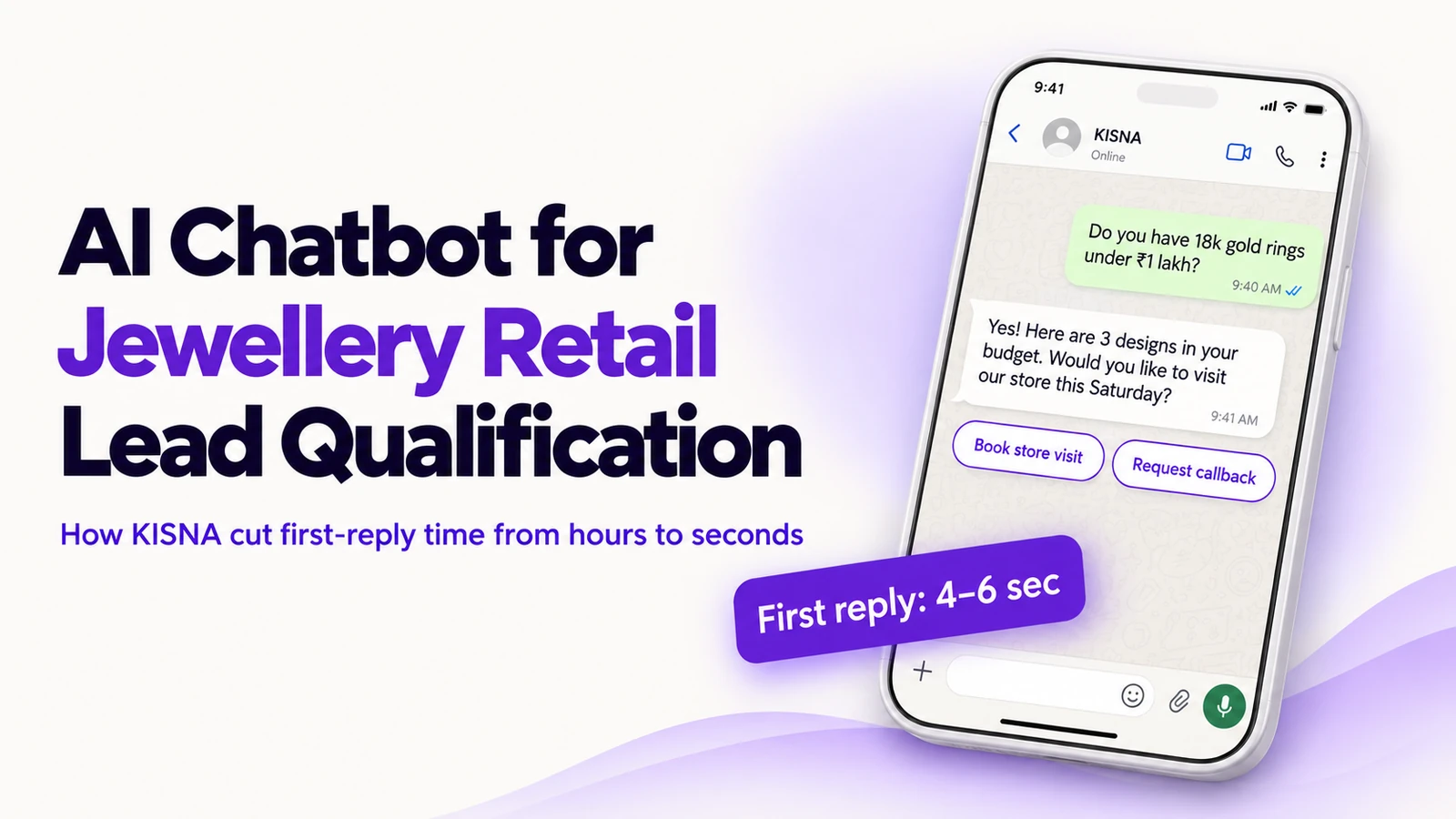
An AI chatbot for jewellery retail lead qualification replies to every enquiry within seconds, on your website and on WhatsApp, at any hour. It asks the questions a jewellery sales team would ask, sorts serious buyers from browsers, books store visits, and writes every answer into your CRM. Your team then spends its time on leads worth calling.
The lead that arrived at 11 pm got a reply at 10 am
Most lost leads are not lost to a competitor's better offer. They are lost to silence. A buyer fills in your website form at 11 pm, after the kids are asleep. Your sales team sees it at 10 am, works through the weekend backlog, and calls at noon. By then the buyer has spoken to two other companies.
Speed matters more than most sales leaders assume. In a study of 1.25 million sales leads at 42 US companies, Harvard Business Review found that firms contacting a lead within an hour were nearly seven times as likely to qualify it as firms that waited even one hour longer. Against firms that waited 24 hours or more, the advantage was more than 60 times.
The problem is not effort. Sales teams work set hours, enquiries do not, and a person can only hold one conversation at a time.
An AI chatbot closes that gap. The chatbot does not replace your sales team. It makes sure no enquiry waits, and that your team starts each day with qualified leads.
What is an AI chatbot for jewellery retail lead qualification?
An AI chatbot for jewellery retail lead qualification is software that holds a natural conversation with a new enquiry, asks your qualifying questions, and decides what should happen next. It runs on your website, on WhatsApp, or both, from one brain.
An AI web chatbot is the same assistant placed on your website, where it greets visitors, answers questions and captures details. A WhatsApp chatbot for business does the same job inside WhatsApp, where many customers prefer to message.
Qualification is the part that matters. The chatbot learns your criteria: budget, occasion, metal and stone preference, timeline. It asks for them one at a time and adapts when the customer jumps ahead. Older rule-based bots forced people through rigid menus. An AI chatbot understands free text, so "I need an 18k gold engagement ring under a lakh before December" counts as an answer to four questions at once.
How does an AI chatbot qualify a jewellery lead?
A well-built jewellery retail lead qualification chatbot follows the same path every time, and every step is visible to your team. A typical enquiry runs like this.

- The customer writes in. A visitor opens the chat on your website or messages your WhatsApp number at 11 pm.
- The chatbot answers the question first. It reads the message, finds the answer in your own product catalogue, price guidance and FAQs, and replies in plain language.
- It qualifies while it helps. Between answers, it asks the questions your sales team needs, without turning the chat into a form.
- It checks your systems. It looks up stock, design availability or the right store in your inventory or booking tool.
- It offers a next step. A qualified buyer is offered two or three real slots from a salesperson's calendar and books one.
- It writes everything to the CRM. Contact details, answers, a short summary and a lead score land in the lead record, so nobody re-asks the same questions.
Chatbot CRM integration separates a useful assistant from a chat window. Without it, the speed advantage disappears at the first handoff.
When does the chatbot hand over to a person?
A good chatbot knows its limits and hands over early. Complaints, complex pricing, negotiations and sensitive personal situations go straight to a person. The handover carries the full conversation and the lead's answers, so the customer never repeats themselves.
Your team sets the rules. A high-value lead can trigger an instant alert to a named salesperson. A frustrated customer can go to a supervisor.
Customer data and messaging are covered by consent and data-protection rules in most markets, such as GDPR in Europe and PDPL in Saudi Arabia. A responsible build works within them from day one.
Should a jewellery chatbot run on web chat, WhatsApp or both?
The right channel depends on where your customers already talk to you, and the best setup runs one assistant on both. Website chat suits buyers who are researching designs and prices before they visit. WhatsApp suits buyers who want to keep the conversation going on their phone, and it is a primary customer channel for jewellery retail in markets such as the Gulf.
WhatsApp has rules of its own. Under Meta's WhatsApp Business Platform rules, a business can reply freely for 24 hours after a customer's last message. After that window closes, it can only send pre-approved template messages. Your follow-up design has to respect that window, or messages will not go out.
Running both channels from one assistant means the same knowledge, the same questions and the same CRM record. A customer who moves from your website to WhatsApp is still one lead.
| Web form and callback | Human live chat | AI chatbot (web and WhatsApp) | |
|---|---|---|---|
| Hours covered | Office hours | Staffed hours | Around the clock |
| First reply | When someone calls back | When an agent is free | Within seconds |
| Qualification | Done later by phone | Depends on the agent | Same questions, every time |
| CRM entry | Typed by hand | Often typed by hand | Written automatically |
At KISNA, a 4-to-6-hour wait became 4 to 6 seconds

KISNA Diamond & Gold shows what this looks like in a working sales operation. Before the chatbot, a customer who messaged KISNA waited 4 to 6 hours on average for an agent to reply. Clara.ai built an AI chatbot for KISNA on WhatsApp and connected it to the company's systems. The first reply now arrives in 4 to 6 seconds.
The chatbot does more than reply quickly. It answers product questions, then offers a store-visit booking or a callback request. Around 24% of the people who message KISNA go on to complete one of the two.
Out of every 100 conversations, the chatbot handles 89 from start to finish. The other 11 go to a person. Those are the conversations that should reach a person: qualified buyers who need a salesperson to turn interest into a purchase, and customers who need help with an existing order.
The CRM connection carries its own saving. With conversations and lead details written into the CRM automatically, KISNA's team saves more than 60 hours of manual entry every week.
KISNA's feedback to Clara.ai was direct. Its salespeople used to spend hours working through hundreds of leads to find the single-digit percentage worth pursuing. With the chatbot doing that first pass, turnaround time fell sharply, sales improved, and the team reports a significant effect on its P&L.
How does Clara.ai build and deploy a jewellery chatbot?
Clara.ai is an AI implementation company that builds, deploys and manages AI chatbots, calling agents and operations dashboards. Clara.ai diagnoses before it builds, and the work usually starts with one chatbot on one workflow, proven on real traffic before anything expands.
- Understand the workflow. Map how leads arrive today, who answers them, and where they stall.
- Measure the baseline. Record current response times, lead volumes and conversion so improvement can be proven, not claimed.
- Build on real data. Train the assistant on your own documents and connect it to your CRM, calendar and inventory. A version 1 demo is ready within 7 days of receiving your material.
- Run it beside your team. Launch on live traffic while your salespeople review conversations.
- Keep the human handover. Set clear rules for when and how a person takes over, with full context.
- Manage and improve it. Review conversations every month, tighten the questions and add new answers as your offer changes.
The chatbot is one part of a single system. An operations intelligence dashboard shows what the conversations mean: lead quality by source, response times, and which salespeople convert the leads they receive. Where a lead needs a voice conversation, an AI calling agent can follow up by phone.
Clara.ai works with 19 active enterprise clients across 12 industries, in India and the Gulf, from jewellery retail to real estate and healthcare.

Questions jewellery retailers ask about AI lead qualification chatbots
What results can an AI chatbot for jewellery retail lead qualification deliver?
Results depend on your volumes and process, but one deployment shows the range. At KISNA Diamond & Gold, the first reply went from 4 to 6 hours to 4 to 6 seconds. Around 24% of people who messaged completed a store-visit or callback request, and the chatbot handled 89 of every 100 conversations without a person.
Can one chatbot work on both my website and WhatsApp?
Yes. A well-built assistant runs from one knowledge base and one set of rules, then appears on your website, on WhatsApp, or both. The customer gets the same answers on either channel, and your CRM holds one record per lead. A buyer who switches from website chat to WhatsApp stays a single lead.
Will an AI chatbot replace my sales team?
No. A lead qualification chatbot handles the first conversation: answering questions, collecting details and booking meetings. Your salespeople still run the meetings, negotiate and close. At KISNA Diamond & Gold, 11 of every 100 conversations go to a person, including qualified buyers who need a salesperson to convert them.
How long does it take to deploy a jewellery retail lead qualification chatbot?
Clara.ai builds a version 1 demo within 7 days of receiving your material, such as product catalogues, price guidance and qualifying questions. Full deployment then depends on how many systems the chatbot must connect to. A focused first workflow, such as qualifying website and WhatsApp enquiries and booking store visits, is the fastest place to start.
What does a jewellery retail chatbot need to connect to?
At minimum, a lead qualification chatbot needs your product catalogue and your CRM. Most also connect to a calendar for store-visit booking, and many connect to inventory so answers reflect real stock and store availability. Without these connections, your team still copies details by hand and the speed benefit is lost.